
There’s a good chance your yoga bolster is sitting in a corner right now, doing a great impression of expensive home decor.
Maybe you bought it during a wellness kick. Maybe a teacher recommended one and you nodded along without totally knowing why. Either way, it’s time to put it to work, because learning how to use a yoga bolster properly might be the lowest-effort upgrade your evenings have ever seen.
A bolster isn’t a pillow. It’s firm and structured, built to hold your body weight without collapsing, so your muscles can actually switch off instead of quietly bracing to keep you stable. That difference matters more than it sounds. In a randomized controlled trial published in Psychoneuroendocrinology, restorative yoga (poses held for long stretches with prop support) measurably improved cortisol rhythms in participants. A 2020 study in the Journal of Sports Science and Medicine pushed it further: one 90-minute yoga stretching session significantly lowered salivary cortisol and raised parasympathetic activity, the “rest and digest” side of your nervous system.
Put simply, you drape yourself over the right support, hold still, and breathe. Your nervous system handles the rest. Here are ten ways to do that, plus a 20-minute evening routine at the end.
Why a Bolster Works When Bed Pillows Don’t
One thing trips people up right away, so let’s clear it up. A couch cushion feels soft and lovely, but it compresses 40 to 50 percent the second you lean on it. Your body senses the wobble and keeps muscles half-engaged to compensate. That is the opposite of relaxing.
A real yoga bolster is densely packed (cotton batting, buckwheat hulls, or firm foam) and keeps its height under load. That stable platform is what lets your spine, hips, and shoulders actually let go. Studio owners learn this fast: commercial-grade bolsters with firm fill and washable covers survive years of daily classes, while soft decorative pillows go flat within weeks.
Which shape does which job:
| Bolster type | Best for | Support level | Stability |
| Rectangular (standard) | Restorative poses, full-torso support | High / firm | Excellent, flat base, won’t roll |
| Round (cylindrical) | Under knees, gentle backbends, heart openers | High / firm | Moderate, can roll on hard floors |
| Pranayama (slim) | Chest opening, breathwork, smaller frames | Targeted / firm | High, low profile |
| Junior | Petite practitioners, travel | Medium / firm | Excellent |
Buying just one? Make it a rectangular standard. Still not sure you need one at all? We get into that in our guide on whether you actually need a yoga bolster.
1. Supported Child’s Pose (Balasana): The Full-Body Exhale
If you only ever learn one bolster pose, learn this one. It feels less like exercise and more like someone handing you permission to stop.
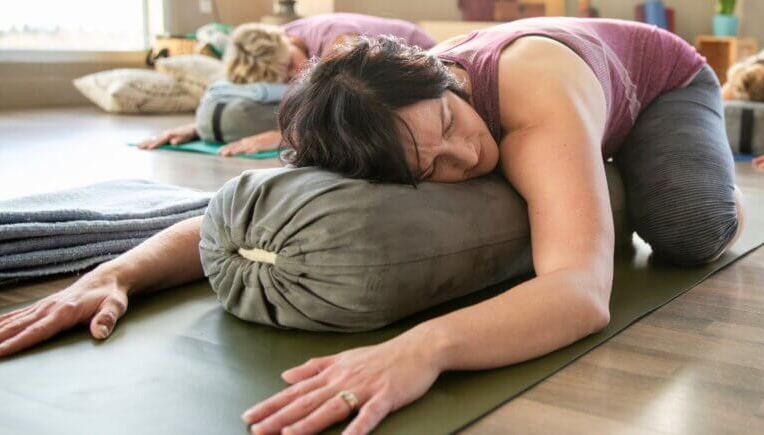
Kneel with your knees wide and big toes touching, and lay the bolster lengthwise in front of you, pulled snug against your body. Fold forward and let your belly, chest, and one cheek sink into it. Your arms go wherever they want. Halfway through, turn your head the other way so your neck stays even.
Give it three to five minutes. The gentle pressure across the front of your body, plus the curled, protected shape, does something real to the nervous system. Teachers call it the reset-button pose. After a brutal day, you’ll understand why.
2. Legs-Up-the-Wall (Viparita Karani): For Heavy, Tired Legs
Been on your feet all day? Or welded to a desk chair, which is somehow worse? This mild inversion fixes both. Elevating the legs lets gravity carry blood back toward the heart, and a bolster under your pelvis turns a good pose into a great one.
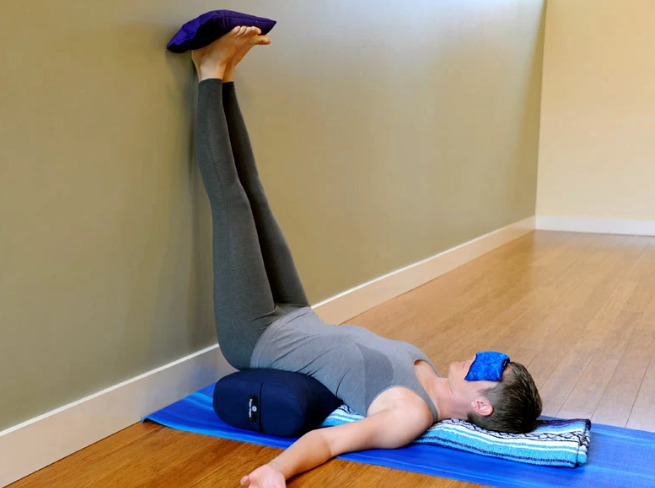
Place the bolster horizontally a few inches from a wall. Sit sideways on it with one hip touching the wall, then swing your legs up as you lower your back to the floor. Your pelvis stays propped, legs rest up the wall, arms flop wide with palms up.
Five to ten minutes. Skip this one if you have glaucoma, since inversions raise pressure in the eyes. And fair warning: this is the pose most likely to make you doze off on the floor, so set a quiet timer if you have anywhere to be.
3. Supported Savasana: The Lower Back’s Best Friend
Lying flat on the floor sounds restful until your lower back starts complaining two minutes in. Slide a round bolster under your knees and the pelvis tilts just enough for the lumbar spine to settle. Suddenly savasana actually feels like rest.
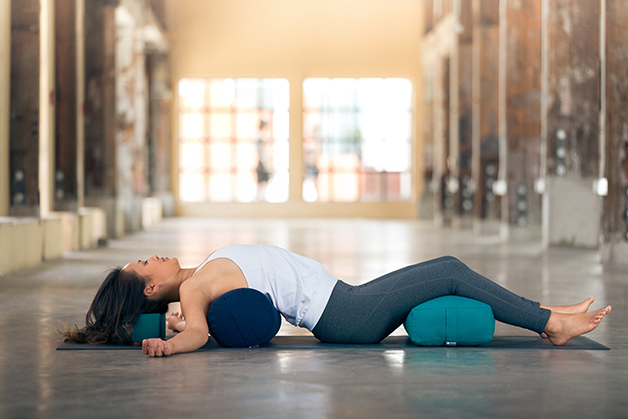
So: lie back, bolster under the knees, feet flopped open, arms by your sides, palms up. Run cold? Pull a light blanket over yourself. Stay anywhere from five to fifteen minutes.
This kind of supported stillness is where the sleep research gets interesting. In a national survey cited by the Sleep Foundation, over 55% of yoga practitioners report better sleep and more than 85% report reduced stress. A lot of those numbers get made right here, on the floor, doing nothing on purpose.
4. Reclined Bound Angle (Supta Baddha Konasana): The Heart-and-Hip Opener
This is the pose in every restorative yoga photo you’ve ever scrolled past, and for once the hype holds up. It opens the hips and chest at the same time, the two places desk workers and stressed-out humans store the most tension.
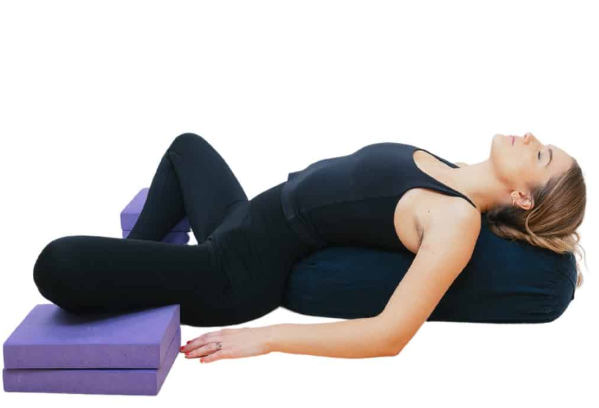
Set the bolster lengthwise behind you. Bring the soles of your feet together, let your knees fall open, then recline slowly until your spine and head rest fully on the bolster. Hips complaining? Slide blocks, books, or folded blankets under your outer knees. Head tipping back past the end? Prop it with a folded blanket so your chin angles slightly toward your chest.
Stay five to ten minutes, breathing into the front of the body. Some people get unexpectedly emotional in this one. That’s normal, and it passes.
Related Reading: Top 8 Tpe Yoga Mat Manufacturers In Germany For Custom Branding
5. Supported Fish Pose: Undo the Desk Hunch
Eight hours hunched over a keyboard drags your shoulders forward and squashes your ribcage, which means you physically can’t take a full breath. Supported fish reverses that shape without any effort on your part.
Sit with your tailbone against the front edge of a lengthwise bolster, then lie back along it. Arms open wide, palms up. Legs can be straight, knees bent, or soles together in bound angle. Dealer’s choice. If your head hangs off the end, tuck a block or firm blanket under it.
Three to eight minutes. With the chest lifted and the ribs free to move, breathing deepens on its own, and that’s exactly the mechanical trigger your parasympathetic nervous system responds to.
6. Supported Bridge (Setu Bandha Sarvangasana): The Passive Backbend
Regular bridge pose is work. Supported bridge isn’t. The bolster holds you up while gravity does the stretching.
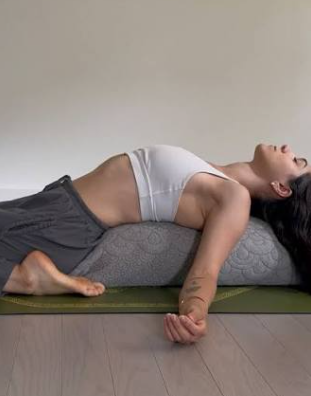
Lie on your back, knees bent, feet flat on the floor. Press into your feet, lift your hips, and slide the bolster under your sacrum. That’s the flat bone at the very base of your spine. Not your lower back, not your tailbone. Settle your full weight onto it, then either keep the knees bent or straighten your legs slowly for more release through the hip flexors.
Three to five minutes, and it’s especially good after long drives or flights, when your hip flexors have been shortened for hours. Placement matters more here than in any other pose on this list. Too high and it wobbles; too low and it digs in. You’ll feel it the moment it lands right.
7. Seated Forward Fold Over the Bolster: Hamstrings Without the Strain
Forcing a forward fold with tight hamstrings is how people end up with grumpy lower backs. The fix is to stop reaching down toward your legs and rest up onto support instead.
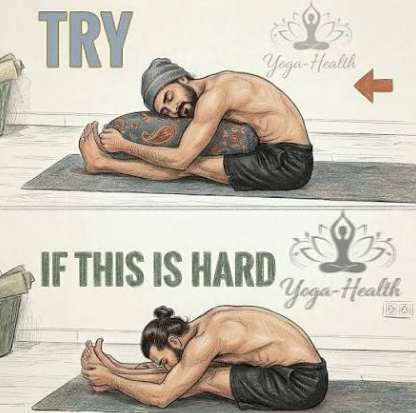
Sit with your legs out in front of you (bent is fine, honestly, bend them as much as you need) and lay the bolster across your thighs. Hinge from the hips and rest your torso and arms along it. Not high enough? Stack a folded blanket on top.
Hold two to four minutes. Forward folds have a quiet, inward quality to them, and of the ten poses here, this is the one people most often describe as meditative.
8. Supine Twist With Support: Wring Out the Spine
Twists unglue the muscles along your spine and give your insides a gentle massage, and doing them over a bolster means your legs aren’t working to hold the shape.
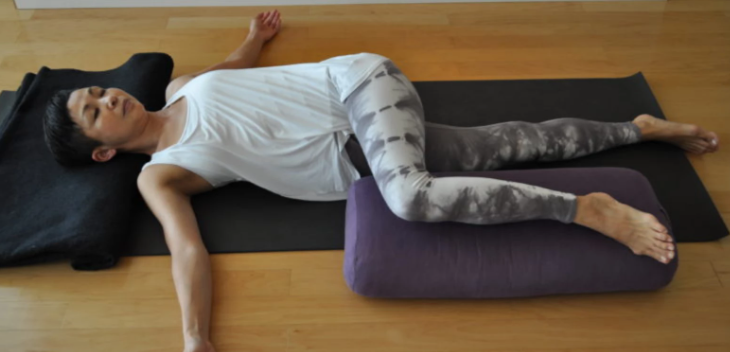
Lie on your back with the bolster lengthwise beside your left hip. Hug your right knee toward your chest, then guide it across your body until it rests on the bolster. Reach your right arm out to the side and let your eyes follow it. Two to three minutes, then switch sides.
Because the supported knee takes the load off your lower back, the release goes deeper than a regular twist. It’s a nice one to finish with before savasana, especially paired with slow breathing: in for four counts, out for six.
9. Meditation Seat: Sit Longer, Fidget Less
Ever tried to meditate and spent the whole ten minutes thinking about your numb foot? Sitting flat on the floor rounds your lower back and forces your spine to fight gravity. Elevating the hips above the knees tips the pelvis forward a touch, so the spine stacks upright on its own.
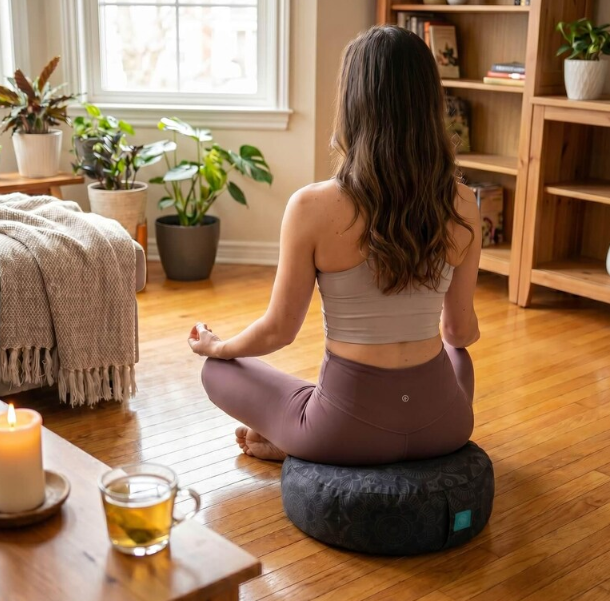
Sit on the front edge of the bolster, cross-legged, or kneel with it between your heels, saddle style. Your knees should drop below hip level. If they hover in the air, tuck a folded blanket under them.
Sit five to twenty minutes. The difference from sitting on the floor is not subtle. Most people double their comfortable sitting time on the first try.
10. The Bedtime Wind-Down: Bolster Yoga for Sleep
This is where it all comes together. A short sequence before bed tells your body the day is officially over, and the research here is solid. In one Harvard Health–cited study, people with insomnia who practiced yoga for eight weeks fell asleep 37% faster. A separate trial had participants sleeping 36 minutes longer a night on average. With roughly a third of adults reporting insomnia symptoms, fifteen minutes on a bolster is a cheap experiment worth running.
Your 20-minute evening sequence:
| Order | Pose | Hold time |
| 1 | Supported child’s pose | 4 min |
| 2 | Supported bridge | 3 min |
| 3 | Supine twist (both sides) | 4 min |
| 4 | Legs-up-the-wall | 5 min |
| 5 | Supported savasana | 4 min |
Lights dim, phone in another room, long exhales the whole way through (in for four, out for six). Three or four nights a week is plenty. Restorative practice works partly through conditioning, so regular beats long. Treat it like brushing your teeth, not like a workout.
A Few Safety Notes Before You Melt Into the Floor
Restorative yoga is about as low-risk as movement gets. A 2024 systematic review of 13 randomized controlled trials found real stress-reduction benefits with zero reported adverse events. Still, a few things are worth knowing:
- Neck first, always. In any reclined pose, your chin should tip slightly toward your chest. If your head drops backward, add height under it.
- Inversions and eye pressure don’t mix. Skip legs-up-the-wall and supported bridge if you have glaucoma or uncontrolled high blood pressure, or clear it with your doctor first.
- Pregnancy changes the rules. After the first trimester, favor side-lying versions of reclined poses instead of lying flat on your back.
- Mild stretch or gentle pressure is fine. Numbness, tingling, or anything sharp means come out of the pose and add more support.
For Studios, Brands, and Bulk Buyers
Reading this as a studio owner or retailer rather than a practitioner? Then the bolster question shifts from “which pose” to “which product.” Restorative and yin classes are among the fastest-growing formats on studio schedules, and with the global yoga market sitting around USD 127 billion in 2025 and projected to nearly double by 2033, props aren’t an afterthought purchase anymore.
What actually matters when you’re sourcing yoga studio equipment at scale:
- Fill density. Commercial bolsters need firm cotton or foam that holds its height after thousands of hours of bodies. Cheap fill goes flat within months.
- Washable, removable covers. Non-negotiable for shared studio use.
- Certifications. REACH, RoHS, OEKO-TEX. Retail buyers and their customers ask about these now.
- Custom branding. A private label bolster line with your logo and colors turns a class prop into a retail product sitting by the studio door.
Before any wholesale or bulk order, ask the yoga bolster manufacturer for fill specifications, cover fabric details, and batch testing records. In the interest of full transparency, this is what we make at FDM Yoga: OEM/ODM yoga bolsters and props with custom logo options, low MOQs, and BSCI-certified production. But the checklist above applies whoever you end up sourcing from.
Frequently Asked Questions
Can I use a regular pillow instead of a yoga bolster?
For a session or two, firm couch cushions will do the job. Bed pillows squash too much to hold alignment, though. Fine as a one-off, frustrating for a regular practice. The firmness is the whole point.
Is a round or rectangular bolster better for relaxation?
Rectangular is the more versatile buy: stable, flat, and ideal for full-torso support in poses like child’s pose and reclined bound angle. Round shines under the knees in savasana and for gentle backbends. Buying one? Go rectangular first.
How long should I hold restorative yoga poses?
Anywhere from two to fifteen minutes. Start around three to five if you’re new. The nervous system benefits build with time in the pose, so one long comfortable hold beats three short ones.
Can a yoga bolster help with lower back pain?
Supported savasana with the knees propped, or supported bridge, takes load off the lumbar spine and lets the muscles around it release. Plenty of people with mild back grumbles get real relief this way. Sharp or persistent pain is a doctor question, not a yoga question.
How often should I practice to see results?
Two to four sessions a week, even just 10 to 15 minutes at a time. The sleep research shows a dose-response pattern: the more consistent the practice, the fewer the disturbances.
Are yoga bolsters worth it for beginners?
Honestly, maybe more than for advanced students. Beginners tend to be tighter, and the bolster removes the strain that makes floor poses miserable, which is usually the thing that makes people quit. Per dollar, it’s one of the best-value props in yoga.
Where to Start Tonight
A yoga bolster isn’t a crutch for people who are “bad” at yoga. It’s a way to let your nervous system do something modern life rarely allows: power all the way down. Ten poses, one firm cushion, zero athleticism required.
Start with supported child’s pose tonight. Five minutes, that’s all. Your spine will notice the difference before your brain does, and once it does, that corner decoration is about to get a lot more use.