
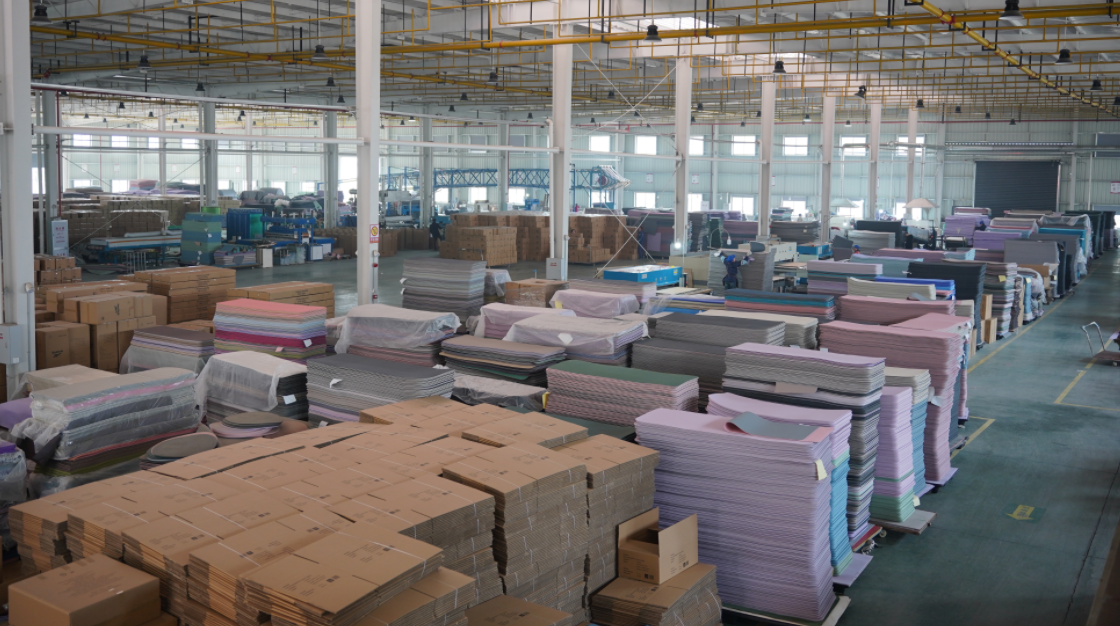
Type “tapete de yoga” into Mercado Livre and you’ll scroll past hundreds of near-identical mats. Same thickness, same five colors, same stock photos. Most are imported generics, and most are forgettable. That sameness is exactly the opportunity: with 6 to 8 million Brazilians now practicing yoga, the studios, retailers, and new brands serving them need product that doesn’t look like everything else on the page.
Getting that product means finding the right yoga mat manufacturers in Brazil, or factories abroad that actually understand Brazilian buyers. It’s the unglamorous part of the business, and it’s where margins are made or lost. Pick well and you control design, pricing, and restocking speed. Pick badly and you’re stuck discounting a container of mats nobody wanted in the first place.
We’ve spent a decade on the manufacturing side of this industry, answering the same buyer questions week after week. Which factories actually do private label? Who takes small first orders? What does importing into Brazil really cost? This guide answers them with eight options worth your time, plus a framework for choosing between them.
Why Brazil Is a Market Worth Sourcing For
Let’s start with the numbers, because they explain a lot.
Brazil’s yoga market generated roughly USD 4.1 billion in 2025, according to Grand View Research, and it’s projected to more than double to USD 8.8 billion by 2033. That’s a 10.1% compound annual growth rate, making Brazil the fastest-growing yoga market in Latin America. YOGI TIMES puts the practitioner base at roughly 3 to 4% of the population, with plenty of room left to grow.
On the product side, the global yoga and pilates mats market was valued at about USD 15.1 billion in 2025 (Dataintelo), and Latin America’s growth is concentrated in exactly three countries: Brazil, Mexico, and Colombia. Brazil sits at the center of that demand.
There’s another angle most buyers miss. The natural rubber tree, Hevea brasiliensis, is literally named after Brazil. The country has deep roots in rubber production, which gives local manufacturers a genuine story to tell with eco-friendly natural rubber mats. For brands selling to conscious consumers, that origin story has marketing value you can’t fake.
The Top 8 Yoga Mat Manufacturers for Brazil in 2026
Quick note on the mix below: not every company here is a factory with smokestacks in Sao Paulo state. Some are domestic Brazilian producers, some are local brands with wholesale programs, and some are international OEM specialists that ship to Brazilian importers every week. That range reflects how sourcing into Brazil actually works.
1. FDM Yoga: Best Overall for Private Label and Custom Orders
Full disclosure first: this is us. Wuhan FDM Eco Fitness has manufactured custom yoga mats since 2015, and Brazilian importers, studios, and Amazon sellers make up a growing share of our client base. We’ve included ourselves because the fit is real, and we’ll let the specs do the talking.
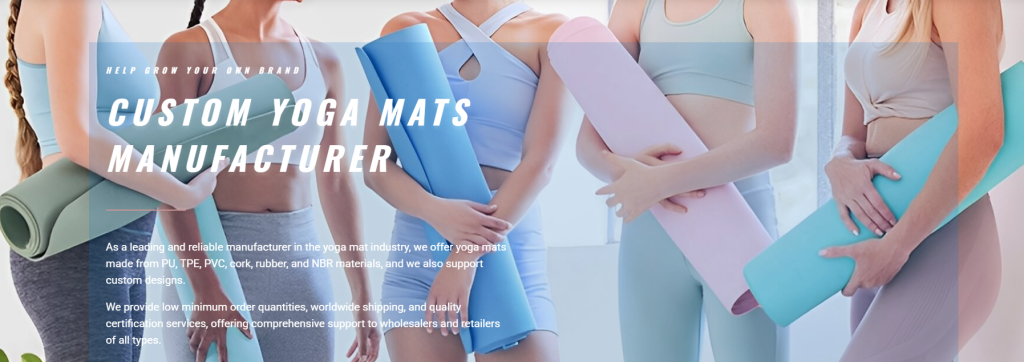
FDM works across six material families: natural rubber, PU, TPE, cork, PVC, and NBR. Customization covers Pantone-matched colors, laser-engraved or printed logos, six proprietary surface textures, and thicknesses from 4mm travel mats up to 20mm rehabilitation mats. If you want a custom size for kids’ mats or extra-wide studio mats, that’s standard work for the factory.
The numbers behind the operation: annual production above 2 million mats, a defect rate kept under 0.3%, and certifications including BSCI, GRS, SGS, RoHS, REACH, and OEKO-TEX 100. Sampling takes 7 to 14 days, and global delivery runs 40 to 50 days, with shipments already going to more than 30 countries.
What buyers tend to care about most is the MOQ. FDM accepts small trial orders, which matters if you’re testing the Brazilian market before committing to a container. More than 500 brands worldwide have run repeat orders with the factory, and the repurchase rate sits around 87%.
Best for: brand owners and wholesalers who want full private label control with a low-risk first order.
2. Acte Sports: Brazil’s Homegrown Wholesale Powerhouse
If you’ve walked into a Brazilian sporting goods store, you’ve seen Acte Sports. The brand is one of the most widely distributed fitness accessory names in the country, covering yoga mats, resistance bands, weights, and general gym accessories.
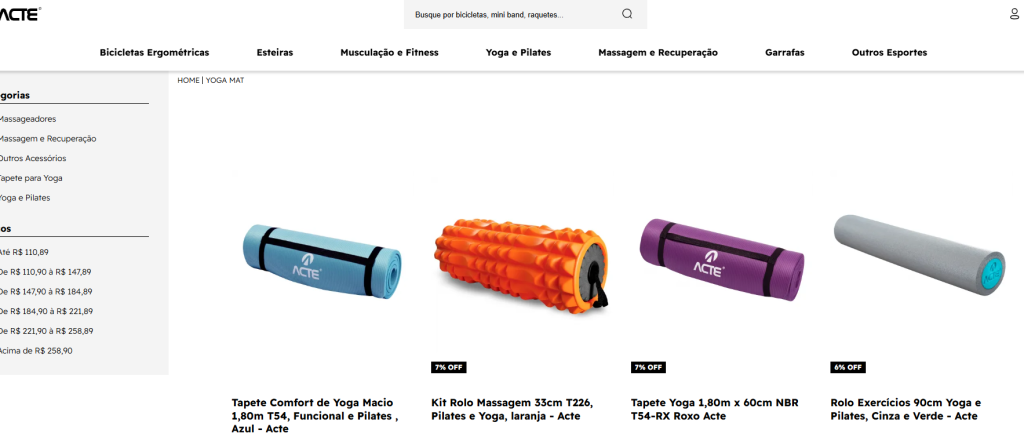
Acte’s strength is local presence. Their products sit on shelves at major retailers across Brazil, and a 2023 consumer price survey by Procon Aracaju listed their yoga mats alongside international names like Decathlon’s Kimjaly. For resellers, that brand recognition transfers: customers already trust the name.
The trade-off is customization depth. Acte operates primarily as a branded wholesale supplier rather than a private label factory, so you’ll mostly be reselling their designs rather than creating your own. For gyms and retailers that want reliable stock with fast domestic delivery, that’s often exactly right.
Best for: Brazilian retailers and gym chains that want branded stock with zero import hassle.
3. Ekomat Yoga: The Eco Champion with Amazon Roots
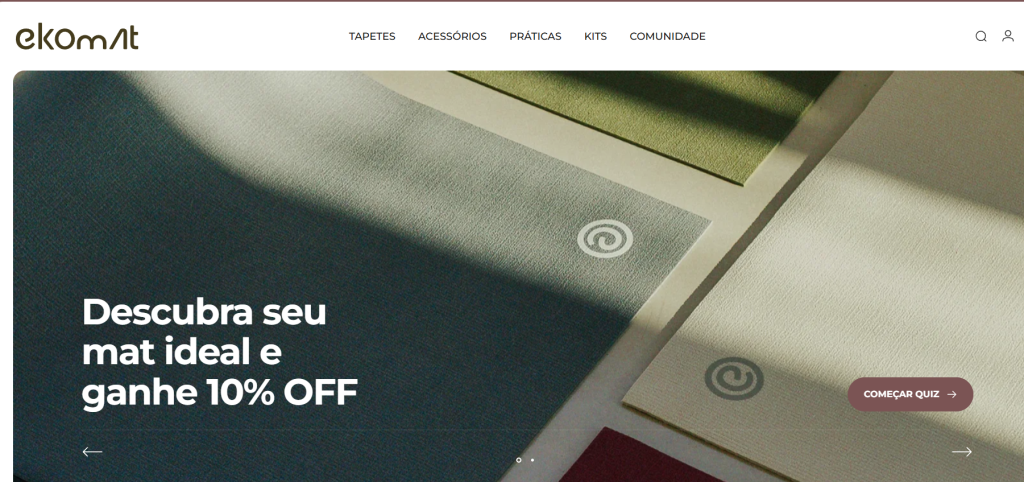
Ekomat Yoga was one of the first Brazilian producers to build its entire identity around sustainable mats. While most local competitors built catalogs on cheap PVC foam, Ekomat went the other direction: ecological rubber constructions and high-durability designs aimed at practitioners who keep a mat for years, not months.
For private label buyers, that specialization is the appeal. Ecological rubber taps directly into the Amazon origin story we mentioned earlier, giving your brand a sustainability narrative with real substance behind it. The mats are built for durability, which matters commercially in two ways: fewer warranty headaches for you, and a product that studios can put through daily class schedules without watching it peel apart in six months.
The positioning does mean a higher price band than foam-based domestic suppliers, so Ekomat fits brands selling to eco-conscious consumers in Brazil’s urban markets, where end customers accept a premium for materials they feel good about. Studios building a “green” identity get the same benefit: the mats themselves become part of the brand statement.
Best for: wellness brands and studios where sustainability is the core selling point, not a footnote.
4. Gili Store: Homegrown Yoga and Wellness Specialist
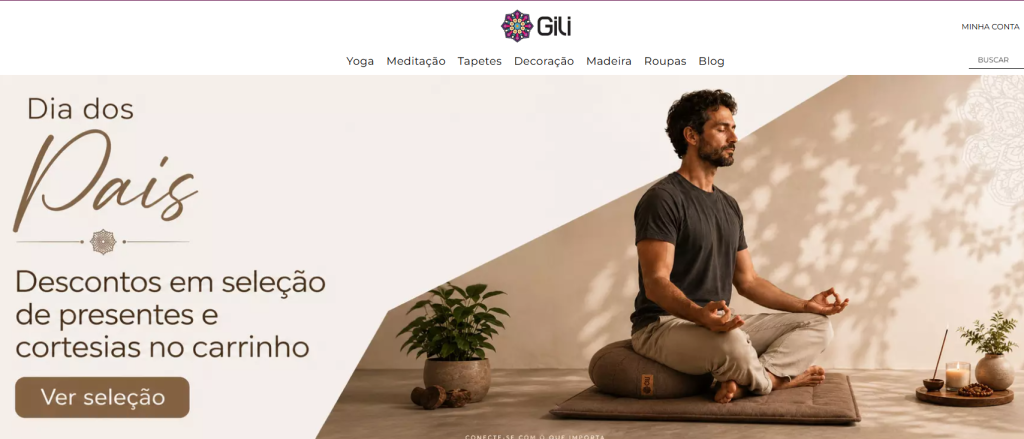
Most Brazilian sporting goods companies treat yoga mats as one SKU among hundreds. Gili Store went the opposite way, building its production around yoga mats, meditation chairs, and wellness accessories specifically. That focus shows up in the details: native production lines tuned for the category rather than adapted from general foam goods.
For buyers, the wellness-only catalog matters more than it might seem. A yoga mat supplier that lives in this niche understands what studio owners ask for, which thicknesses sell in the Brazilian market, and how mats get used in daily class rotation. You’re not explaining the product category to your supplier; they’re already fluent in it.
Gili Store fits resellers, studios, and small brands that want a domestic partner with real category depth, plus the option to expand into adjacent wellness products later without finding a second supplier.
Best for: yoga-focused retailers and studios that want a specialist rather than a generalist.
5. Paz em Gaia: Low-MOQ Custom Branding for Studios
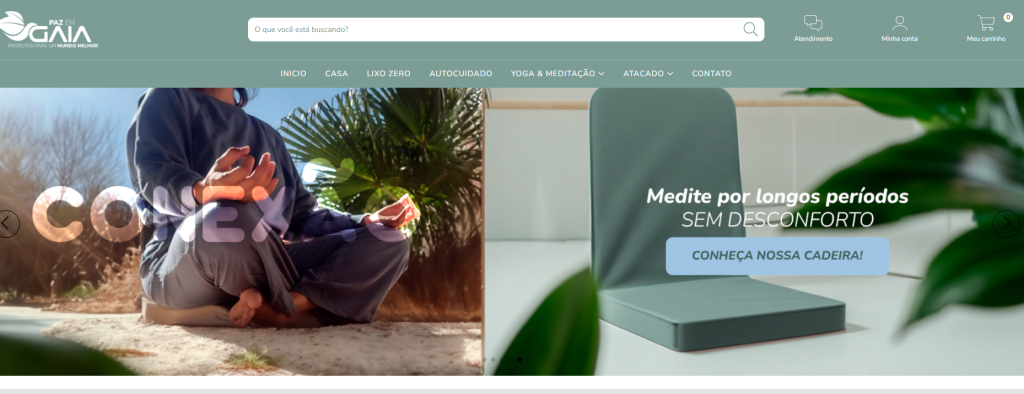
Here’s a common problem: a yoga studio wants 50 mats with its logo for retail and class use, and every yoga mat factory quote starts at 500 units. Paz em Gaia built its offer around exactly that gap, with wholesale yoga mats and custom branding available in batches typically starting around 30 units.
That threshold changes who can play. Independent studios, freelance teachers building a side brand, and corporate wellness programs ordering branded mats for employees all become viable private label buyers. The company leans into this audience, tailoring its service for studio and corporate orders rather than chasing container-scale contracts.
The trade-off is predictable: per-unit pricing at 30 to 100 units won’t match a 2,000-unit factory run, and customization centers on branding rather than materials engineering. But for testing a branded product line with minimal cash at risk, this is one of the lowest-commitment entry points in the Brazilian market.
Best for: studios, teachers, and corporate wellness buyers who need branded mats in small batches.
6. Eureka EVA: High-Volume Custom EVA Production
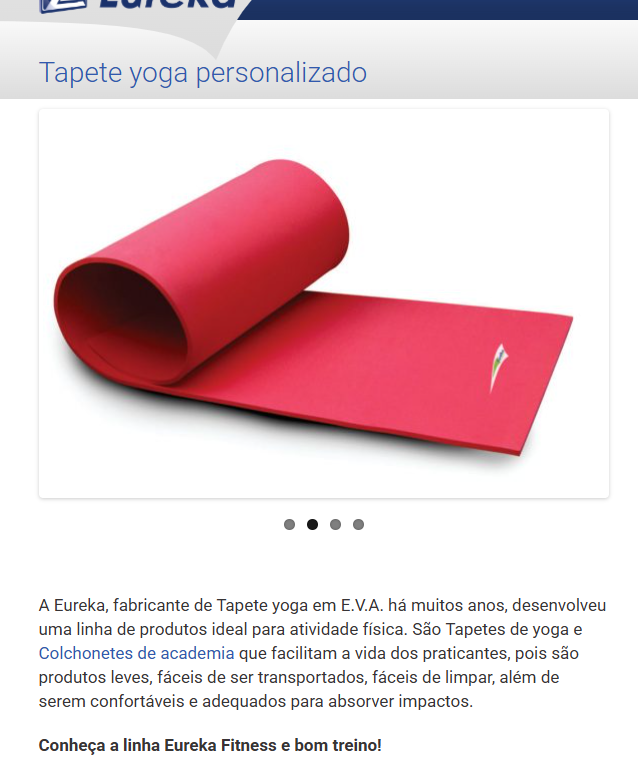
Eureka EVA operates at the industrial end of the spectrum, running a national factory focused on lightweight, shock-absorbing EVA mats for fitness and yoga. EVA foam dominates the gym and studio segment for good reason: it’s light, cushions well, resists moisture, and costs a fraction of natural rubber.
Scale is the story here. When a retail chain or distributor needs consistent volume with custom specs, Eureka’s setup handles thickness, density, and color requirements at production volumes that smaller shops can’t match. Shock absorption is a particular strength, which makes their mats a natural fit for fitness studios where floor work and high-impact movement happen alongside yoga.
One practical note: EVA performs differently from rubber or PU in grip and feel, so order samples and test them in actual class conditions before committing. For the price segment Eureka serves, though, the value per unit is hard to beat domestically.
Best for: retail chains and distributors needing custom EVA mats at serious volume.
7. AMS EVA: Logo-Ready Mats for Promotional and Institutional Orders
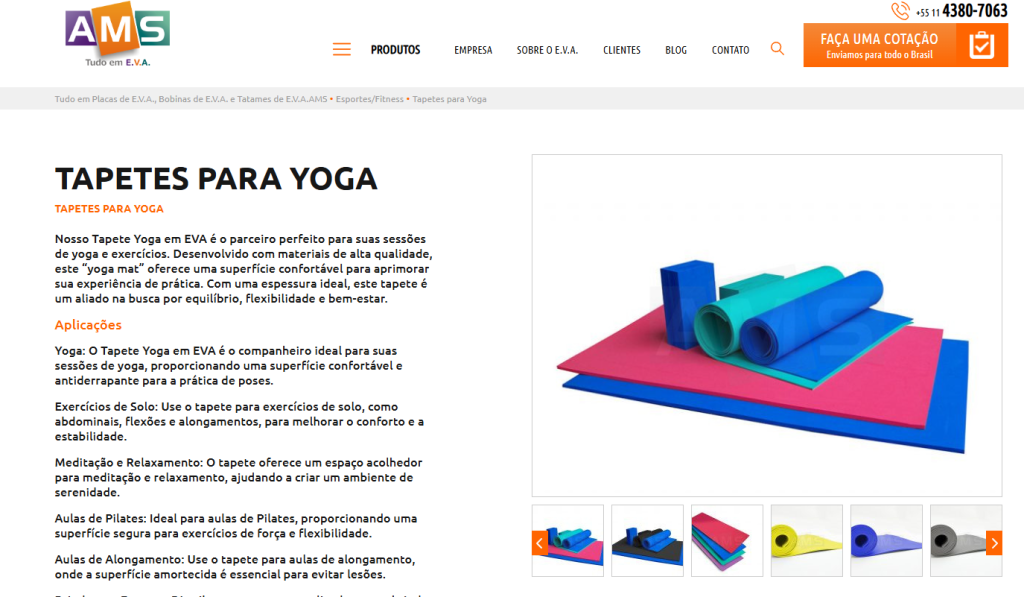
AMS EVA works as an industrial-scale EVA converter, and they’ve carved out a specific lane: custom logo printing on fitness and yoga mats for corporate promotional kits and schools. Think less “yoga brand launch” and more “500 branded mats for a company’s wellness event” or “mats for a municipal school sports program.”
Promotional and institutional orders run on different logic than retail. Buyers care about delivery reliability, straightforward pricing, and a logo that looks clean on the mat, not about premium surface textures. AMS EVA’s converting operation is built for exactly that, turning EVA stock into finished branded goods efficiently.
For Brazilian companies with employee wellness budgets, gyms running member promotions, or education buyers, this is a practical domestic source. Brands building a premium retail product should look at other entries on this list instead.
Best for: corporate gifting, promotional campaigns, and school or institutional procurement.
8. Eva Brasil: The Raw Material Backbone
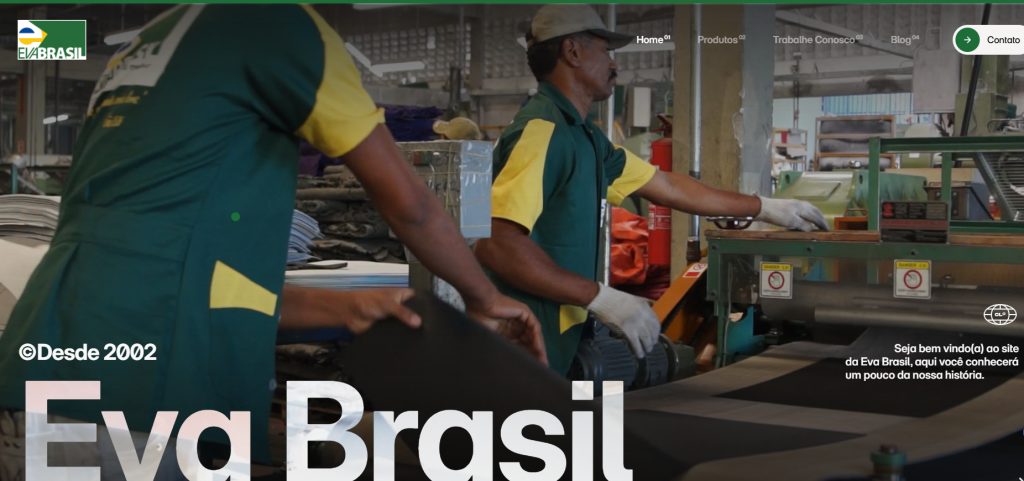
Eva Brasil plays a different role than everyone else on this list. They’re a major industrial supplier of raw EVA sheets and rolled materials, the stuff that flows into sporting goods and fitness manufacturing across the country. In other words, some of the mats sold by other Brazilian brands likely started as Eva Brasil material.
Why should a buyer care about an upstream supplier? Two scenarios. First, if you already have cutting, printing, or finishing capability (or a local partner that does), buying direct from the material source strips out a full layer of margin. Second, if you’re evaluating Brazilian suppliers generally, knowing where the raw material comes from helps you ask sharper questions about quality and pricing.
This is not a turnkey private label partner. There are no retail-ready branded yoga mats coming out the door. But for buyers with manufacturing relationships or unusually large requirements, going upstream is where real cost control lives.
Best for: buyers with finishing capability or large-scale requirements who want material-direct pricing.
At a Glance: Comparing Your Options
| Manufacturer | Type | Private Label | Typical MOQ | Best For |
| FDM Yoga | OEM factory (serves Brazil) | Full customization | Low trial orders | Brand builders wanting control |
| Acte Sports | Brazilian brand/wholesaler | Limited | Low to mid | Domestic retail stock |
| Surya Brasil | Brazilian eco manufacturer | Yes, eco-focused | ~250 units | Sustainability-led brands |
| Hidrolight | Brazilian manufacturer | Limited | Mid | Pharmacies, regional retail |
| Muvin | Brazilian manufacturer/distributor | Localized branding | Mid | Studios and gyms wanting own-brand gear |
| Realtex | Brazilian foam manufacturer | Limited | Mid | Entry and mid-range NBR/PVC mats |
| Lider Pel / Mercur | Industrial polymer processors | Custom extrusion (OEM) | High volume | Large-scale custom foam specs |
| LIVE! | Brazilian brand, vertical | Partnership model | Negotiated | Co-branded bundles |
Sourcing Tips Specific to Brazil
A few lessons that come up again and again with Brazilian orders.
Always order samples first. Any serious manufacturer offers sampling, and the 7 to 14 days it takes is the cheapest insurance in the process. Test the grip with sweaty hands, roll and unroll the mat fifty times, and smell it. Off-gassing from cheap PVC is the fastest way to earn one-star reviews.
Understand the import math. Brazil’s import duties on finished goods can be steep, and landed cost includes freight, insurance, taxes, and customs brokerage. Get a DDP (Delivered Duty Paid) quote if your supplier offers it, because it converts all of that uncertainty into one number you can price against.
Plan around the calendar. Brazilian retail peaks around the New Year fitness season and pre-summer months (September through December in the Southern Hemisphere). Working backward with a 40 to 50 day production and shipping window means placing orders by mid-year for the summer rush.
Confirm certifications match your channel. Selling to large retail chains or corporate wellness programs often requires documented compliance: REACH and RoHS for materials, BSCI for social compliance at the factory. Ask for certificates upfront, not after the container ships.
Communicate in writing, in detail. Portuguese-speaking support helps, but specification sheets matter more. Thickness tolerances, Pantone color references, packaging requirements, and inspection criteria should all live in a document both sides sign.
Related Reading: 5 Best Custom Yoga Mat Manufacturers in Europe: Eco-Friendly & Wholesale Options
FAQ
How much does it cost to private label yoga mats for the Brazilian market?
Unit costs vary widely by material and order size. Basic TPE mats in bulk can start at a few dollars per unit, while natural rubber or PU mats with custom printing run significantly higher. Add freight, Brazilian import duties, and local fulfillment to build your landed cost. Retail yoga mats in Brazil sell between R 25 and R 110, so work backward from your target retail price.
What is a realistic MOQ for a first private label order?
It depends on the supplier type. Full-service OEM factories like FDM Yoga accept low trial orders, sometimes a few hundred units or less. Eco and premium specialists typically start around 250 units, and industrial extrusion processors expect significantly larger commitments. Domestic Brazilian wholesalers can go lower still, since you’re buying existing stock.
Should I source natural rubber mats from Brazil specifically?
The rubber tree is native to the Amazon, and Brazilian natural rubber carries a strong sustainability story. That said, most large-scale natural rubber mat production happens in Asia, where processing infrastructure is concentrated. If the Amazon origin story is central to your brand, a partner like Surya Brasil makes sense. If you want natural rubber mats at sharper pricing, an OEM factory with certified rubber sourcing is usually the better route.
How long does the whole process take, from first contact to delivery?
Plan for 60 to 90 days end to end. Sampling takes 1 to 2 weeks, production 3 to 5 weeks depending on order size, and ocean freight to Brazilian ports another 4 to 6 weeks. Air freight cuts shipping to days but can double or triple your per-unit logistics cost, so it only makes sense for small, urgent restocks.
Do I need certifications to sell yoga mats in Brazil?
There’s no single mandatory certification for yoga mats, but retailers and corporate buyers increasingly ask for material safety documentation. REACH and RoHS compliance covers chemical safety, and OEKO-TEX 100 certifies textiles are free from harmful substances. Having these ready removes friction from wholesale negotiations.
Wrapping Up
Brazil’s yoga market is growing at double digits, the consumer base is expanding beyond the big coastal cities, and the supply side finally offers real choice. The right manufacturer depends less on rankings and more on your stage: domestic wholesalers for speed and simplicity, OEM factories for control and margin, and eco specialists when sustainability is the brand itself.
If you’re exploring private label yoga mats for the Brazilian market, we’re happy to walk you through materials, MOQs, and landed cost estimates. FDM Yoga offers free samples, so you can judge the quality with your own hands before spending a dollar on inventory. Reach out through fdmyoga.com and tell us what you’re building.