
Somebody at the gym is on a black high-density roller right now, working their quad, jaw clenched, breathing in short sharp bursts. When they get up they’ll feel like they accomplished something. That feeling is the problem.
Somewhere along the way, foam rolling picked up the same logic as a cold plunge: if it doesn’t hurt, it isn’t working. That belief has probably sold more firm rollers than any marketing campaign — and it’s kept a lot of people from rolling at all, because they tried the painful version once and quietly retired it under the bed.
A soft foam roller is the version most people should have started with. Not the beginner’s consolation prize. The one that matches how soft tissue actually responds to pressure.
This article covers what the research genuinely supports, which benefits are real, who should choose soft density, and — importantly — who shouldn’t.
Short Answer: What a Soft Foam Roller Actually Does for You
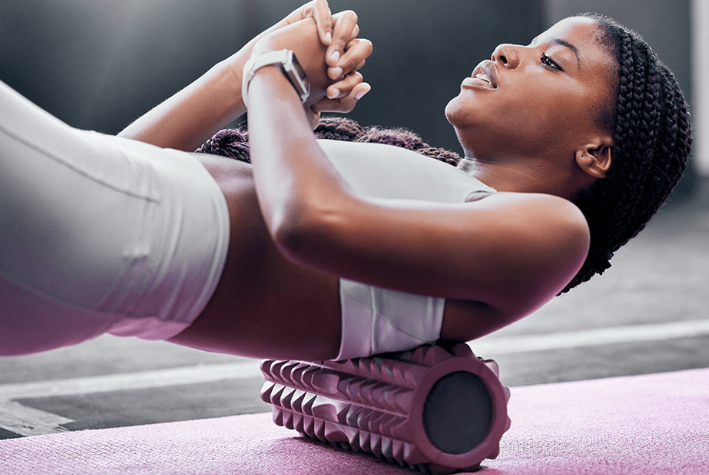
A soft foam roller delivers the same core mechanisms as a firm one — increased tissue compliance, improved range of motion, reduced pain perception — at a pressure level that doesn’t trigger your body’s protective tension response. For beginners, older adults, sensitive body areas, and pre-workout warm-ups, that lower pressure isn’t a compromise. It’s often what makes the session productive.
The five benefits, in short:
- You’ll actually use it consistently — adherence beats intensity
- Less pain means less muscle guarding — tense muscles resist release
- Safer on bony and sensitive areas — shins, thoracic spine, near joints
- Accessible to populations firm rollers exclude — seniors, post-injury, deconditioned
- Better suited to warm-ups — where the evidence for rolling is actually strongest
Each of those is unpacked below. First, though, the part most product pages skip.
Benefit 1 — You’ll Actually Use It
This is the least scientific benefit on the list and probably the most important one.
Foam rolling produces small effects per session. Small effects only matter when they accumulate. Which means the tool that gets used four or five times a week beats the tool that gets used twice and then becomes a doorstop.
Firm rollers have a high abandonment rate for exactly this reason. The first session is genuinely unpleasant for a deconditioned user, and there’s no immediate payoff big enough to justify going back. A soft roller lowers the barrier to the point where rolling becomes a habit rather than an ordeal — something you do while watching TV instead of something you psych yourself up for.
Consistency is the multiplier. Everything else in this article assumes you’re actually using the thing.
Benefit 2 — Less Pain Means Less Muscle Guarding
When you apply pressure sharp enough to hurt, your body doesn’t relax into it. It braces.
That protective response is involuntary. Muscles contract around the area under threat, the surrounding tissue tightens, and your breathing goes shallow — which itself raises sympathetic nervous system activity. You are now trying to release tension in a muscle that is actively generating tension in response to what you’re doing.
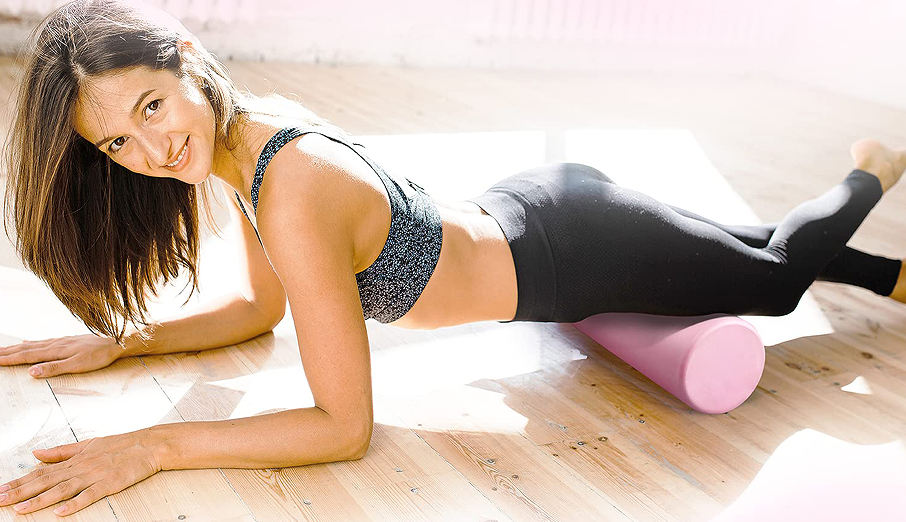
This is the mechanism the more balanced voices in the industry point to. The framing used by mobility specialists is that too little pressure provides insufficient release, while too much causes pain that triggers protective muscle guarding. There’s a working window, and past a certain point more force moves you further from the goal, not closer.
A soft roller keeps most users inside that window without needing to think about it. You can breathe normally, stay relaxed, and let the tissue respond — which is the condition the parasympathetic and pain-modulation mechanisms described above actually depend on.
The practical test: if you can’t maintain slow, regular breathing while rolling, the pressure is too high for that area on that day.
Benefit 3 — Safer on Sensitive and Bony Areas
Not every part of your body has a thick muscle layer protecting it. A high-density roller applied to a bony or nerve-dense area isn’t producing deeper release — it’s just producing pain, and occasionally bruising.
| Body area | Soft roller | Firm roller | Notes |
|---|---|---|---|
| Calves | Excellent | Good | Soft is usually sufficient; calves respond well to gentle pressure |
| IT band / outer thigh | Excellent | Often too intense | This is the classic area where firm rollers cause people to quit |
| Thoracic spine (upper back) | Excellent | Risky | You’re rolling over vertebrae — soft density is the safer choice |
| Shins / tibialis | Excellent | Poor fit | Very little tissue between roller and bone |
| Hamstrings | Very good | Good | Either works; soft is fine for most users |
| Quads | Good | Good | Larger, denser muscle — heavier users may want medium |
| Glutes | Adequate | Better | Dense muscle mass; soft may not reach depth for larger athletes |
| Lats / upper back sides | Very good | Good | Soft handles the ribcage contact better |
| Lower back | Avoid entirely | Avoid entirely | No roller belongs here — unsupported lumbar spine |
The pattern: soft density is equal or better on most areas, and only clearly gives ground on dense, high-mass muscle groups for heavier or well-trained users.
Benefit 4 — Accessible to People Firm Rollers Exclude
An entire set of users can’t productively use a high-density roller. For them, soft density isn’t a preference — it’s the only version that works.
Beginners and deconditioned users. Untrained tissue is more sensitive to compression, and the pain threshold rises with exposure over weeks and months. Starting soft and progressing later is the sensible sequence. Starting firm mostly produces people who don’t foam roll.
Older adults. Reduced tissue elasticity, thinner subcutaneous padding, and often lower bone density make high-pressure tools inappropriate. Soft rollers let mobility work stay part of the routine, which is exactly the population where maintaining range of motion matters most.
Post-injury and postpartum users. Once a clinician has cleared gentle soft-tissue work, soft density is the standard starting point. This is a large part of why rehab clinics stock soft rollers specifically. Get clearance first — this article isn’t medical advice, and rolling near a healing injury without guidance is a bad idea.
Naturally pressure-sensitive people. Pain tolerance varies enormously between individuals for reasons that have nothing to do with fitness or willpower. Someone who finds a firm roller unbearable isn’t weak; their nervous system just reports pressure differently. A soft roller gets them the same mechanisms at a workable intensity.
Benefit 5 — A Better Warm-Up Tool
Recall the meta-analysis conclusion: the evidence justifies foam rolling more as a warm-up activity than as a recovery tool. Pre-rolling produced the flexibility gain (+4.0%) without impairing subsequent performance.
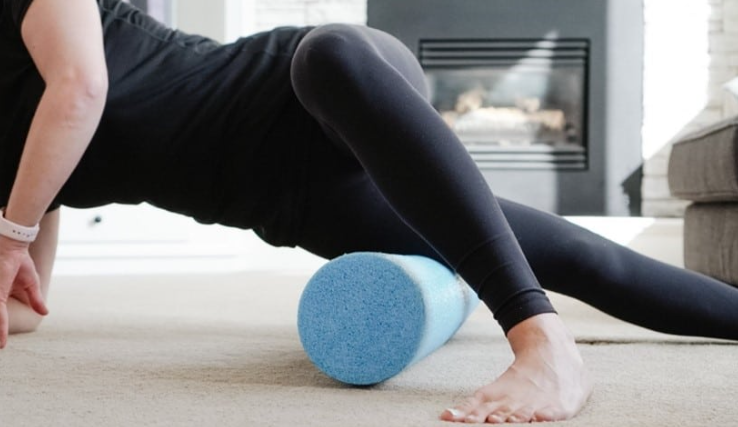
Soft density fits this use case particularly well. Before training, you want to increase tissue compliance and get blood moving — you don’t want to fatigue the muscle or leave it tender before you load it. An aggressive deep-tissue session five minutes before squats can work against you.
A practical pre-workout routine: 30–60 seconds per major area, moderate pressure, moving continuously. Two to three minutes total. That’s enough to capture the flexibility benefit without spending your session on the floor.
Soft vs Medium vs Firm: An Honest Comparison
| Soft (low density) | Medium | Firm (high density) | |
|---|---|---|---|
| Typical material | EVA foam | EVA or moulded EPP | High-density EPP, or foam over a rigid core |
| Feel | Noticeable give under bodyweight | Moderate give | Minimal give |
| Best for | Beginners, seniors, sensitive areas, warm-ups | General population, most use cases | Experienced users, dense muscle, deep work |
| Main strength | Tolerable — you’ll keep using it | Versatile across body areas and users | Reaches depth on large muscle groups |
| Main weakness | May under-deliver on dense glutes/quads for heavier users | Compromise on both ends | Pain can trigger guarding; excludes many users |
| Durability | Lower — compresses over time | Good | Excellent |
| Heavier users (100kg+) | May bottom out | Usually appropriate | Often the right call |
When You Should NOT Buy a Soft Roller
Straight answer, because pretending otherwise helps nobody:
- You’re a heavier or well-muscled athlete working large muscle groups. If you’re over roughly 100 kg or carry significant muscle mass, a soft roller will compress under your bodyweight before it delivers meaningful pressure to your quads or glutes. Go medium.
- You’ve been rolling consistently for months and no longer feel much. Your tissue and pain tolerance have adapted. That’s the signal to progress density, which is exactly how it’s supposed to work.
- You specifically want deep trigger-point work. That’s a different tool — a firm textured roller or a massage ball, not a soft cylinder.
- You need it to survive heavy institutional use. Soft EVA rollers develop compression set faster. For a clinic running twenty sessions a day, durability may outweigh comfort — see the sourcing section below.
Critics of soft rollers make a fair point on the durability side: low-density foam compresses more readily under bodyweight and degrades faster than high-density alternatives. That’s a real tradeoff, and it’s a material-quality question as much as a density question. Which brings us to materials.
Materials: EVA, EPP, and Why Compression Set Matters
Two materials dominate the category, and the difference explains most quality complaints.
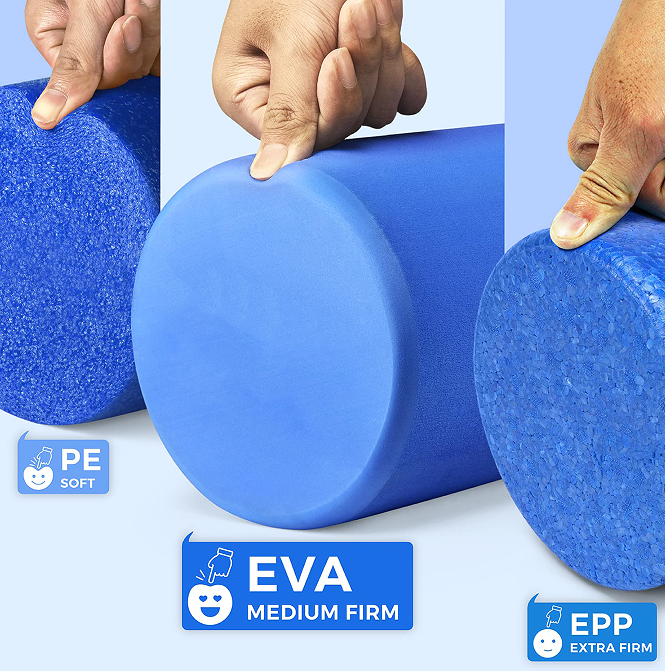
EVA (ethylene-vinyl acetate) is the softer, more cushioned option. It feels smoother and more forgiving, and it’s the standard material for genuinely soft rollers. Its weakness is compression set — over months of repeated loading, lower-grade EVA gradually loses its ability to spring back, and the roller develops flat spots or simply feels dead.
EPP (expanded polypropylene) is a moulded bead foam that’s more resilient. It’s typically used for medium and firm rollers, but well-made EPP can be produced at lower densities too, giving you a softer feel with better recovery. It costs more.
Compression set is the spec that separates a roller that lasts three years from one that lasts three months. It measures how much permanent deformation a foam retains after being compressed. Consumer product pages almost never publish it. B2B buyers should ask for it directly.
A note on the word “density.” In manufacturing, density is a measurable property in kg/m³. In retail, “soft/medium/firm” is a marketing label with no standard behind it. One brand’s soft is another’s medium. If you’re buying at volume, specify the density figure, not the adjective.
How to Use a Soft Foam Roller Properly
The technique matters more than the tool.
Duration. 30–90 seconds per muscle group. Longer isn’t better; the returns flatten quickly.
Tempo. Slow. Roughly one inch per second. Fast rolling feels productive and accomplishes very little — you’re not giving the tissue time to respond.
When you find a tender spot. Pause and hold for 20–30 seconds, breathing normally, rather than grinding back and forth over it.
Breathing. Slow and regular throughout. If you’re holding your breath, reduce the pressure. This is the simplest self-check there is.
Frequency. Daily is fine. Before training for warm-up, after training or in the evening for soreness and relaxation.
Common mistakes:
- Rolling too fast to feel anything
- Rolling directly over joints — knees, elbows, hips
- Rolling the lower back (unsupported lumbar spine; use a ball on the glutes instead)
- Holding your breath and gritting through pain
- Expecting a single session to fix a chronic issue — it won’t, and persistent pain is a clinician’s job, not a roller’s
Sourcing Soft Foam Rollers in Bulk
If you’re buying for a clinic, facility, gym, or retail line, the decision criteria change substantially.
Why some buyers specifically need soft density
Soft rollers aren’t the general-purpose choice for a commercial gym — but for certain institutional buyers they’re the primary requirement:
- Physical therapy and rehab clinics — patients are by definition deconditioned or recovering
- Senior living and assisted living facilities — reduced tissue tolerance across the entire user base
- Corporate wellness programs — mixed-ability participants, many with no training background
- Postnatal and prenatal fitness programs — gentle soft-tissue work only
- Beginner-focused studios and community fitness programs — first-time users who will abandon anything painful
For these buyers, stocking only firm rollers means a meaningful share of users simply can’t participate.
Related Reading: Best Resistance Band Supplier Wholesale For Gym
The spec that actually matters: compression set
The number one complaint about soft rollers in institutional settings is permanent flattening. A roller used twenty times a day is under a completely different load cycle than a home unit.
What to request from a supplier:
- Density figure in kg/m³, not the marketing adjective
- Compression set test data — the percentage of permanent deformation after a standardized compression period
- Material specification — EVA grade, or EPP with bead structure detail
- Sample units for real-world testing before committing to a full order. Put one in your busiest room for a month.
A foam roller supplier who can answer all four is set up for institutional supply. One who responds only with prices and colors is set up for one-off retail orders.
MOQ, sizing, and customization
Standard sizing runs 33 cm (13″), 45 cm (18″), 60 cm (24″), and 90 cm (36″), typically at 14–15 cm diameter. The 45 cm and 90 cm sizes cover most institutional needs — 45 cm for limbs and portability, 90 cm for full thoracic spine work lying lengthwise.
Customization that tends to earn its cost in this category:
- Colour-coded density tiers — lets clinics assign appropriate rollers at a glance
- Printed logo and facility branding — low cost, meaningful for facility identity and asset control
- Surface finish options — smooth for soft-tissue work, lightly textured for grip
- Retail packaging — necessary for physical retail and Amazon listings
- Custom lengths — for programs with specific storage or usage constraints
Ask about low-MOQ trial runs before committing to a full container on a new product line.
Red flags when vetting a manufacturer
- Can’t provide a density figure in kg/m³
- No compression set or durability data of any kind
- Won’t send pre-production samples
- Uses “soft/medium/firm” as the entire specification
- Pricing far below market with no explanation of material grade
- Vague or unchanging lead times regardless of order size
If you’re comparing suppliers, our bulk foam rollers page covers sizing and customization options.
Quick Decision Guide
| Your situation | What to buy |
|---|---|
| First foam roller, no experience | Soft, 45 cm, smooth EVA |
| Older adult working on mobility | Soft, 90 cm for stability, smooth surface |
| Returning after injury (cleared by clinician) | Soft, 45 cm, start with short sessions |
| General fitness, average build | Medium — the safest all-round pick |
| Heavier or well-muscled athlete | Medium to firm, EPP construction |
| Mainly pre-workout warm-ups | Soft to medium, 90 cm |
| Physical therapy clinic | Soft and medium in colour-coded tiers, EPP for durability |
| Senior living facility | Soft, 90 cm, high-resilience material, easy-clean surface |
| Retail or private label | Two or three density tiers, retail packaging, published specs |
Frequently Asked Questions
Does a soft foam roller actually work? Yes. The mechanisms behind foam rolling — mechanical, neurological, physiological, and psychophysiological — don’t require high pressure. The research shows modest but genuine benefits for flexibility and muscle pain perception, and nothing in it establishes that firmer rollers produce better outcomes.
Is foam rolling supposed to hurt? No. Mild discomfort in a tight area is normal; sharp pain is not. Pain triggers protective muscle guarding, which works against what you’re trying to achieve. If you can’t breathe normally while rolling, reduce the pressure.
Soft or firm foam roller for beginners? Soft. Untrained tissue is more sensitive, and pain tolerance increases with weeks of exposure. Starting soft and progressing later is the sensible sequence — and it’s the version people actually stick with.
How long should I use a foam roller? 30–90 seconds per muscle group, rolling slowly at roughly one inch per second. Two to three minutes total is enough for a pre-workout routine.
Is it better to foam roll before or after a workout? The 2019 Frontiers in Physiology meta-analysis concluded the evidence better justifies foam rolling as a warm-up activity than as a recovery tool. Pre-rolling improved flexibility by 4.0%. Post-rolling’s clearest benefit was reduced muscle pain perception, at 6.0%.
What’s the difference between EVA and EPP foam rollers? EVA is softer and more cushioned but more prone to compression set over time. EPP is a moulded bead foam with better resilience and durability, typically used for medium and firm rollers, though it can be produced at lower densities.
Can you foam roll your lower back? No. The lumbar spine is unsupported in that position. Roll the glutes and the thoracic spine instead, or use a massage ball for targeted glute work.
What’s a typical MOQ for wholesale foam rollers? It varies by material and customization. Standard sizes in stock colours carry lower minimums than custom lengths, custom densities, or branded packaging. Ask suppliers about low-MOQ trial runs when testing a new product line.
The Short Version
A soft foam roller works through the same mechanisms as a firm one, at a pressure your nervous system doesn’t fight. For beginners, older adults, sensitive body areas, and pre-workout warm-ups, that’s not a downgrade — it’s the right specification.
The honest caveats: if you’re a heavier or well-trained athlete working dense muscle, go medium. If you’ve been rolling for months and feel nothing, progress. And if you’re buying for a facility, ask for the density figure and compression set data rather than trusting the word “soft.”
If you’re sourcing at volume, get in touch to discuss densities, sizing, and customization options.