
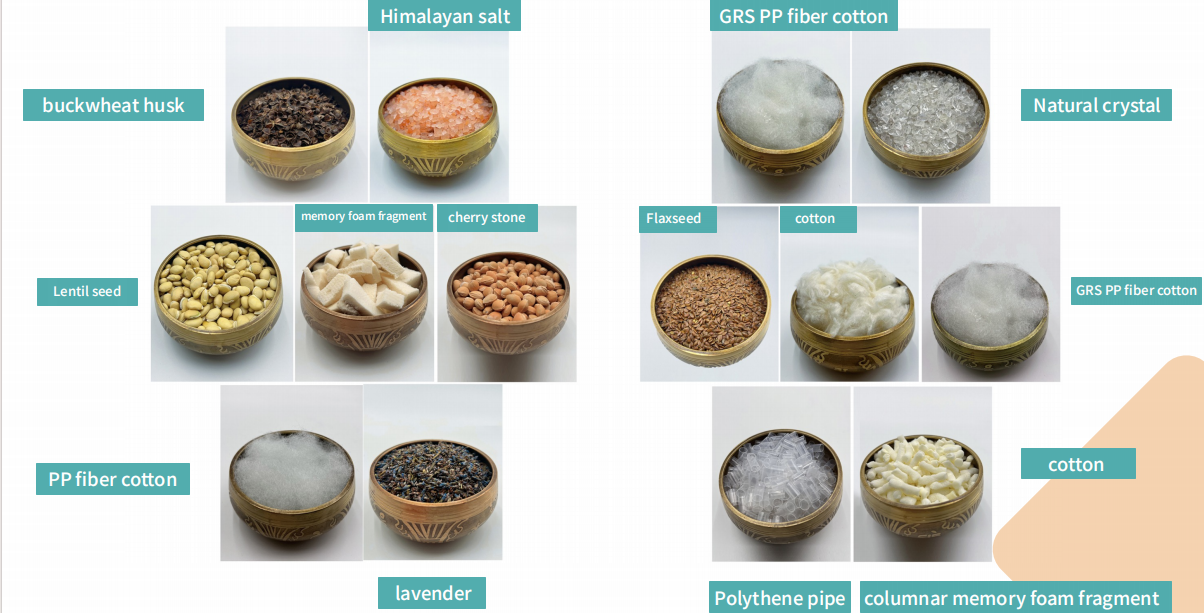
Two years ago you bought a bolster. Sixty dollars, “premium high-density filling” in the listing, and for about eight months it was the best thing in your practice. Then one evening you settled into supported bridge and felt your hips keep going — down, past where they used to stop, until your sacrum was basically on the floor with a flat pancake underneath it.
The bolster didn’t break. It just stopped doing the one job it had.
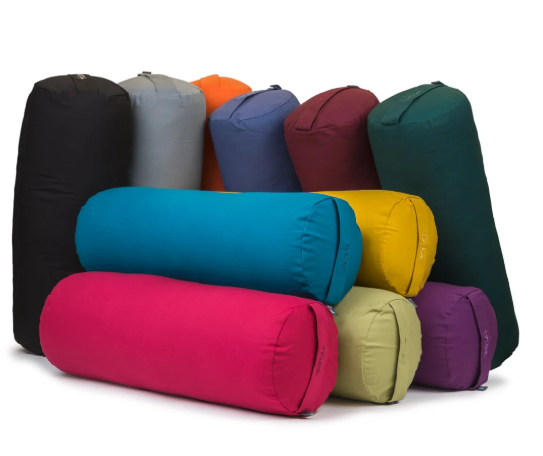
Here’s what nobody tells you before that happens: “high-density filling” is not a specification. It’s a phrase. It appears on 30bolstersand90 bolsters and means nothing measurable in either case. Yoga bolster filling determines whether yours holds its height for eight months or eight years, whether it weighs three pounds or fifteen, and whether it’s a smart buy for a studio ordering forty.
So let’s open a few up.
Short Answer: What Fill Should You Actually Buy?
For most people: firm cotton batting. It holds height under bodyweight, it’s washable at the cover, it lasts five to eight years in home use, and it’s the fill studios default to — for the unglamorous reason that it works.
Buy something else in these specific cases:
| Your situation | Best fill | Why |
|---|---|---|
| Home practice, 2-5x per week | Cotton batting | Best firmness-to-longevity ratio at a fair price |
| You need it light (travel, small frame, mobility limits) | Kapok | Roughly a third the weight of buckwheat, still holds shape |
| Meditation seat is the main use | Buckwheat hulls | Moulds to your sit bones and stays exactly where you put it |
| Maximum firmness for alignment work | High-density foam | Zero compression, completely predictable height |
| Occasional use, 1-2x per week, tight budget | Recycled polyester | Genuinely fine at this frequency — don’t overspend |
| Studio, clinic, or rehab facility | Cotton batting or HD foam | Survives daily multi-user load; refillable or replaceable |
That’s the answer. The rest explains why, and — more usefully — how to tell whether a seller’s fill claim is real.
Still deciding whether you need a bolster at all? We covered whether you actually need one separately. This article assumes you’ve decided yes and are now staring at four products that look identical.
What Yoga Bolster Filling Actually Controls — And What It Doesn’t
Fill gets blamed for everything. It deserves maybe 60% of the blame.
A bolster is three systems: the fill, the casing that contains it, and the cover. Fill determines how it behaves under load. Construction determines whether it stays a bolster at all. Premium cotton inside a loosely-stitched casing migrates to the ends within a year and leaves you with a firm doughnut.
| What you care about | Fill? | Construction? |
|---|---|---|
| Initial firmness | ✅ Yes | Partly |
| Firmness after 2 years | ✅ Mostly | Partly |
| Weight | ✅ Entirely | No |
| Breathability | ✅ Yes | Partly — cover fabric |
| Washability | ✅ Yes | ✅ Cover must be removable |
| Shape retention at edges | Partly | ✅ Mostly — baffles and stitching |
| Fill migration / lumping | Partly | ✅ Mostly |
| Cover durability | ❌ No | ✅ Entirely |
Read that table before you spend $90 on a fill upgrade. If a product page won’t tell you whether the casing is baffled or the cover removable, the fill spec is the least of your problems.
The Six Fills You’ll Actually Encounter
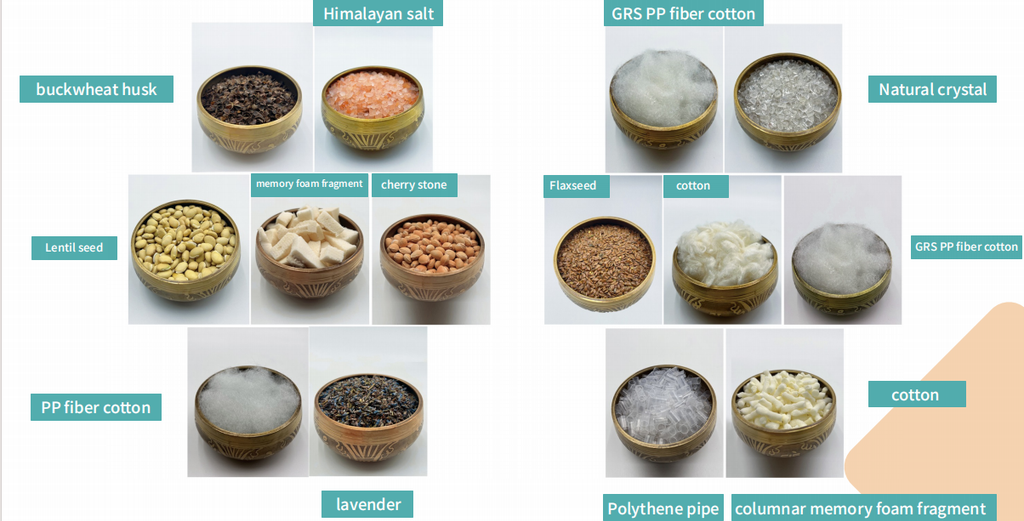
Cotton Batting — the studio default
Layered cotton fibre, compressed and packed dense. What most quality bolsters have been filled with since bolsters became a product category.
It feels firm but not hard. Maybe half an inch of give under an adult torso, then it stops. That’s why it works for restorative poses: enough conformity that it doesn’t feel like lying on a plank, enough resistance that your body stops bracing.
Cotton does compress over time. A five-year-old cotton bolster is measurably shorter than a new one. Good ones are overpacked at the factory to absorb that loss. Cheap ones aren’t, which is why they go flat in a year.
Weight: 5-7 lb at standard size. Lifespan: 5-8 years in home use, 2-4 in a busy studio. Price band: $50-90.
Kapok — the light one
Kapok comes from the seed pods of the Ceiba pentandra tree. The fibres are short — 0.8 to 3.2 cm — and hollow, which is where its whole personality comes from. Britannica describes it as moisture-resistant, quick-drying and buoyant. Buoyant enough that it was the standard filling in life jackets before synthetic foam took over.
For a bolster that means medium-firm support at roughly half the weight of cotton. Three to four pounds instead of six. If you’re small-framed, managing a mobility limitation, or hauling a bolster across town, that’s the entire ballgame.
The catch is clumping. Short hollow fibres don’t interlock the way cotton does, so under repeated compression they migrate and bunch. A kapok bolster needs a firm shake monthly. Do that and it lasts four to six years. Skip it and you’ll have lumps by month eight.
It’s also the most expensive natural fill — kapok is hand-harvested from tropical trees rather than machine-picked from fields.
Buckwheat Hulls — the mouldable one
Not fibre at all. Small hard husks, loose inside the casing, that flow around your body and then lock in place. Sit on a buckwheat bolster and it forms an exact impression of your sit bones and stays there. Nothing else does that.
For meditation, this is the correct answer and it isn’t close. For anything where you want a bolster to hold a consistent shape rather than conform to yours, it’s the wrong tool — the hulls displace and you get a hollow.
Then there’s the weight. A standard 25″ buckwheat bolster runs 8 to 15 pounds. Four times a kapok bolster of identical dimensions. A studio owner restacking forty of those twice a day will feel it within a week.
Now the part almost nobody writes about. A study in the Journal of Korean Medical Science measured endotoxin in new buckwheat pillows versus synthetic ones. Buckwheat came in at a geometric mean of 60,950 EU/g against 4,887 EU/g for synthetic — a ratio of 12.5 to 1. The husk filling itself tested at 14,188 EU/g, putting total endotoxin in a single 1.54 kg pillow at roughly 21.8 million EU. Endotoxin aggravates asthma in dust-mite-sensitised people, and the researchers concluded atopic asthmatics should probably avoid these pillows.
Before you throw yours out, read the qualifier the authors added themselves: the Korean manufacturers in that study don’t wash the husks. The paper notes that US-processed husks are normally cleaned extensively, and nobody has run the follow-up study.
So the honest position: buckwheat isn’t dangerous. But if you have asthma or significant allergies, buy only from a supplier who will confirm in writing that hulls are washed and heat-treated. If they can’t answer that, that’s your answer.
One more note from the same study — after three months, dust mite allergen levels were statistically indistinguishable between buckwheat and synthetic pillows. The mite problem is a cover-and-humidity problem, not a fill problem. Whoever told you buckwheat is naturally mite-proof was overselling.
Polyurethane Foam — the firm one
Solid foam core, sometimes shredded foam, sometimes foam wrapped in a thin batting layer for surface comfort.
Foam is the most predictable fill there is. Exact height, held session after session, no fluffing or migration. For alignment work where the bolster needs to be the same six inches every time, foam is the professional choice.
Two things separate good foam from garbage foam, and product pages almost never mention either.
Density is mass per volume and predicts longevity. ILD (or IFD) measures the force needed to compress the foam by 25% and predicts how firm it feels on day one. These are independent. A soft high-density foam outlives a firm low-density foam even though the firm one feels more substantial in the shop. Upholstery guidance puts high-resilience foam around 2.8 lb/ft³ at roughly 44 ILD for seat cushions, with HR grades running 3-6 lb/ft³.
Low-density foam is the single most common cause of the flat-bolster experience. It feels great for six months. Then it compresses, and it does not come back.
Ask for CertiPUR-US certification. It covers VOC emissions and prohibited flame retardants, and plenty of cheap imports don’t clear it.
Recycled Polyester — the budget one
Spun PET fibre, often from recycled bottles. Soft, cheap, light, washable, and the sustainability story is real — this is genuinely diverted waste.
It’s also the fill that flattens fastest. Polyester has poor recovery under sustained compression, so a bolster used four times a week visibly loses loft inside a year.
Here’s where I’ll disagree with most of the internet: that doesn’t make it a bad purchase. Practise once or twice a week holding poses for five minutes, and a 35polyesterbolsterwillserveyouwellfortwoorthreeyears.Tellingthatpersontospend85 on organic cotton is upselling, not advice. Buy the cheap one. If your practice deepens to daily, buy the good one then — you’ll know exactly what you want by that stage.
Wool — the niche one
Compressed wool batting. Temperature-regulating, moisture-wicking, naturally resistant to microbial growth. Also expensive, heavier than cotton, impossible to machine wash, and off-limits for anyone with a lanolin sensitivity or a vegan practice. Mostly found in small-batch artisan bolsters. Nice if you find one. Not worth hunting for.
Master comparison
| Fill | Firmness | Weight (25″) | Lifespan (home) | Washable | Main failure mode | Price band |
|---|---|---|---|---|---|---|
| Cotton batting | Firm | 5-7 lb | 5-8 yrs | Cover only | Slow compression | $50-90 |
| Kapok | Medium-firm | 3-4 lb | 4-6 yrs | Cover only | Clumping without re-fluffing | $70-110 |
| Buckwheat hulls | Firm, mouldable | 8-15 lb | 7-10 yrs | Hulls removable | Hull breakdown; moisture | $60-100 |
| HD foam | Firm to very firm | 4-6 lb | 6-10 yrs | Cover only | Compression set if low-density | $45-85 |
| Recycled polyester | Soft-medium | 3-5 lb | 1-3 yrs | Often fully | Rapid loft loss | $25-50 |
| Wool | Firm | 6-8 lb | 5-8 yrs | Spot clean only | Felting when wet | $90-140 |
Lifespans assume home use two to five sessions a week. Halve them for studio use.
Allergies, Hygiene, and What the Research Actually Says
Restorative yoga puts your face against this thing for fifteen minutes at a stretch, several times a week. Hygiene isn’t fussy — it’s the use case.
Dust mites: the research points at the cover, not the fill. In the Korean study, buckwheat and synthetic pillows showed similar mite allergen accumulation after three months, and pillow mite levels tracked the mattress underneath. Mites also struggle below roughly 50% relative humidity, which is why the same bolster behaves differently in Arizona and Singapore. Buy a tightly-woven removable cover and wash it monthly. That habit does more than any fill choice.
Off-gassing: foam’s issue. New polyurethane can emit a chemical smell for days to weeks. CertiPUR-US limits VOC emissions. Air a new foam bolster outdoors for 48 hours — and if it still smells, return it.
Mould: buckwheat’s weak point. Hulls absorb ambient moisture. In humid climates they need airing in sunlight every few months, and a buckwheat bolster that gets genuinely wet is finished.
| Fill | Cover washable | Fill washable | Maintenance needed |
|---|---|---|---|
| Cotton batting | ✅ Yes | ❌ No — spot clean, air dry | Occasional airing |
| Kapok | ✅ Yes | ❌ No | Monthly shake and re-fluff |
| Buckwheat | ✅ Yes | ✅ Empty and rinse hulls; dry fully | Air in sun quarterly; replace hulls at 5-7 yrs |
| HD foam | ✅ Yes | ❌ No — never soak | Air new foam before first use |
| Recycled polyester | ✅ Often full machine wash | ✅ Sometimes | Tumble low to restore some loft |
| Wool | ⚠️ Spot clean | ❌ No — felts when wet | Air regularly; store dry |
When the Expensive Fill Is the Wrong Choice
Most bolster content is written by people selling one type of bolster. So here’s the counter-case.
Practise once or twice a week? Buy polyester. A $35 bolster used twice weekly for gentle stretching does the job for two or three years. Premium fills earn their money under frequency and load. Without those, you’re paying for durability you’ll never consume.
Small-framed or limited mobility? Skip buckwheat. It’s the most-recommended fill in meditation circles and a genuinely poor choice for anyone who’ll struggle to move a fifteen-pound object. A prop you wrestle with is a prop you stop using.
Hot, humid climate? Think twice about buckwheat too. It needs airing and sun on a schedule, and most people won’t keep that up. Cotton and foam don’t care about your climate.
Tight budget? Spend it on the cover, not the fill. A mid-range fill in a well-made removable cover with baffled construction outlasts a premium fill in a cheap sewn-shut case. Fill is roughly 60% of bolster longevity. Construction is the other 40% — and it’s the part you can inspect before buying.
And if your bolster went flat in under a year, the fill probably wasn’t the whole story. Undersized fill weight, no baffling, and a casing that let everything migrate produce the same symptom regardless of material.
How Long Should It Last? The Cost-Per-Year Math
Price arguments about bolsters are almost always framed wrong. Nobody buys a bolster once.
| Fill | Typical price | Realistic home lifespan | Cost per year |
|---|---|---|---|
| Recycled polyester | $35 | 2 yrs | ~$17.50 |
| HD foam | $65 | 8 yrs | ~$8.10 |
| Cotton batting | $70 | 6.5 yrs | ~$10.80 |
| Buckwheat hulls | $80 | 8.5 yrs | ~$9.40 |
| Kapok | $90 | 5 yrs | ~$18.00 |
| Wool | $115 | 6.5 yrs | ~$17.70 |
Lifespans are midpoints of the ranges above; home use, two to five sessions weekly.
Two things jump out. High-density foam is the cheapest fill to own over time by a clear margin — it’s just not the most pleasant to lie on. And kapok, the priciest natural fibre, works out no cheaper per year than budget polyester: you’re paying a premium for lightness, not longevity. If weight matters, money well spent. If it doesn’t, you’re buying the wrong thing.

Related Reading: Where Is Hugger Mugger Yoga Mat Made
For Studios, Clinics and Private-Label Brands
Different question entirely. You’re not choosing a bolster, you’re choosing a replacement cycle.
Restorative and yin are among the fastest-growing formats on studio schedules, so props have moved from afterthought to line item. And fill is the one spec you cannot verify from a photo or a brochure — exactly where corners get cut.
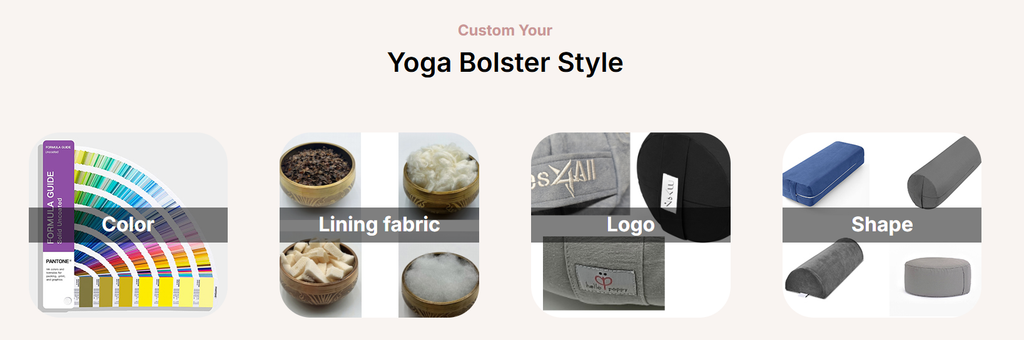
Specs to demand in writing
Not “high-density.” A number.
- Foam: density in lb/ft³ or kg/m³, plus ILD/IFD. Under 1.8 lb/ft³ won’t survive commercial use.
- Cotton or kapok: total fill weight in the finished unit. This is the number quietly reduced when a supplier squeezes margin.
- Buckwheat: hull origin, plus confirmation hulls are washed and heat-treated.
- Cover: fabric weight in GSM, removable yes/no, wash temperature, colourfastness.
- Construction: baffled or unbaffled casing, and stitch density.
Six questions before any bulk order
- What is the fill density or fill weight, as a number?
- Is the casing baffled, or is the fill loose in a single chamber?
- What is the expected height loss after 12 months of daily commercial use?
- Can the unit be refilled or topped up, or is it replace-only?
- Which certifications apply — OEKO-TEX, GOTS, GRS, CertiPUR-US, BSCI — and can I see the certificates?
- What’s the packed shipping weight per unit and per carton?
Red flags: any answer that repeats a marketing adjective instead of a figure; refusal to provide test reports; a certification named without a certificate number.
The refillability lever
Underused. A bolster designed to be topped up through a zipped access panel converts a replacement cost into a maintenance cost. For a forty-unit studio, refreshing fill at year three costs a fraction of re-buying. Most suppliers don’t advertise this even when they can do it.
Shipping weight economics
Forty buckwheat bolsters is up to 600 lb of freight. Forty kapok is around 140 lb. On international shipping that delta can exceed the difference in unit cost — meaning the “cheaper” bolster sometimes isn’t. Run the landed cost, not the unit price.
| Spec | What to ask | Red flag answer |
|---|---|---|
| Fill density | “State density in kg/m³ or fill weight in kg” | “It’s high-density” |
| Casing | “Baffled or single chamber?” | “It’s well made” |
| Longevity | “Expected height loss at 12 months daily use?” | “It lasts for years” |
| Certification | “Certificate numbers for OEKO-TEX / CertiPUR-US?” | Logo shown, no number |
| Refillability | “Can it be topped up? Access panel?” | “You’d just replace it” |
| Shipping | “Packed weight per unit and per carton?” | Vague or unanswered |
Full disclosure: we manufacture bolsters. FDM Yoga does OEM and ODM custom yoga bolsters with BSCI-certified production and low MOQs. The checklist above works on any yoga bloster supplier, including us — and if one gets annoyed at question three, that’s your answer.
Matching Yoga Bolster Filling to Your Practice
| Scenario | Best fill | Second choice | Avoid |
|---|---|---|---|
| Restorative, 3-5x/week | Cotton batting | HD foam | Polyester |
| Yin yoga, long holds | Cotton batting | Buckwheat | Polyester |
| Meditation seat | Buckwheat hulls | Kapok | Soft foam |
| Prenatal | Cotton batting | Kapok | Buckwheat (weight) |
| Injury rehab / alignment | HD foam | Cotton batting | Anything soft |
| Travel / small apartment | Kapok | Polyester | Buckwheat |
| Occasional gentle stretching | Recycled polyester | Kapok | Premium anything |
| Asthma or dust allergy | Cotton (washable cover) | HD foam | Unwashed buckwheat |
| Studio / clinic, high traffic | Cotton batting | HD foam | Polyester |
| Hot humid climate | HD foam | Cotton batting | Buckwheat |
Practical use: find your row, buy the first column, stop researching. For most readers that’s cotton batting, and there’s nothing disappointing about landing on the boring answer.
Frequently Asked Questions
What is the best filling for a yoga bolster? Firm cotton batting for most practitioners. It balances firmness, longevity and price better than anything else, and it’s washable at the cover. Buckwheat if you mainly meditate; kapok if weight is a constraint; high-density foam for maximum firmness with zero maintenance.
Are buckwheat hull bolsters safe? Generally yes, with one caveat. Research found new buckwheat pillows carry endotoxin around 12.5 times higher than synthetic ones, which matters for asthma or dust mite sensitivity. The husks in that study were unwashed. Buy from a supplier who confirms hulls are washed and heat-treated, or choose cotton if you’re atopic.
Why did my yoga bolster go flat? Three usual causes: low-density fill that compressed permanently, insufficient fill weight at manufacture, or an unbaffled casing that let fill migrate to the ends. Polyester flattens fastest. Low-density foam is the sneakiest — it feels firm for the first several months.
Can you wash a yoga bolster? The cover, yes — assuming it’s removable, and if it isn’t, that’s a design failure. The fill, almost never. Cotton, kapok, foam and wool are spot-clean and air-dry only. Buckwheat is the exception: empty the hulls, rinse, dry completely, refill.
Is kapok better than cotton for a bolster? Only if weight is your priority. Kapok is roughly half the weight at similar firmness, but costs more, needs monthly re-fluffing, and lasts a year or two less. Cotton is the better default; kapok answers a specific problem.
How much should a yoga bolster weigh? Between 3 and 15 pounds at standard 25″ × 12″ × 6″, depending entirely on fill. Kapok is lightest at 3-4 lb, buckwheat heaviest at 8-15 lb, cotton in between at 5-7 lb. Repositioning it mid-practice? Stay under 6 pounds.
How long should a yoga bolster last? Five to eight years for cotton in home use, six to ten for high-density foam, one to three for polyester. Studio use roughly halves all of those. A quality bolster that flattens inside two years of home practice was underfilled or badly constructed.
What should I ask a wholesale bolster supplier? Get fill density or fill weight as an actual number, confirm whether the casing is baffled, ask for expected height loss after twelve months of daily use, and request certificate numbers rather than logos. Any of those answered with a marketing adjective — keep looking.
The Short Version
Yoga bolster filling isn’t a marketing word, but “high-density filling” is. The difference between a bolster that lasts eight months and one that lasts eight years comes down to a number the seller either has or doesn’t — density for foam, fill weight for fibre.
For most people the answer is firm cotton batting in a removable washable cover, and you can stop thinking about it. Buy something else only for a specific reason: lightness, mouldability, maximum firmness, or a budget that says once-a-week practice doesn’t need a premium prop.
And whatever you buy — ask for the number first.